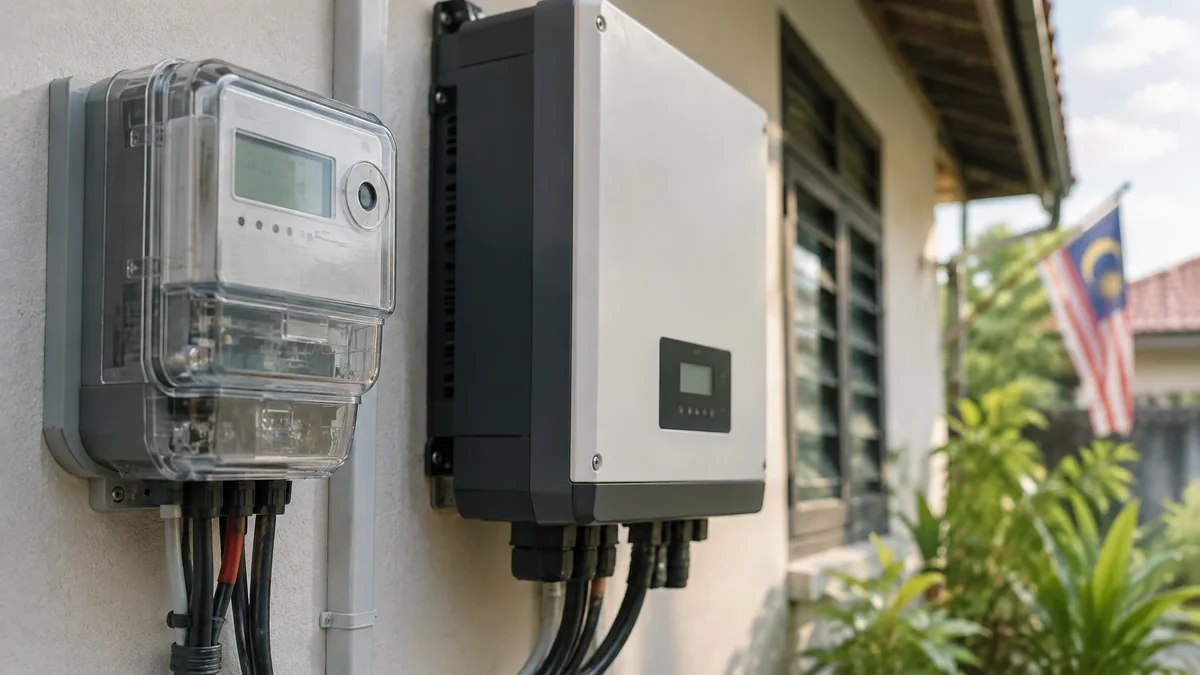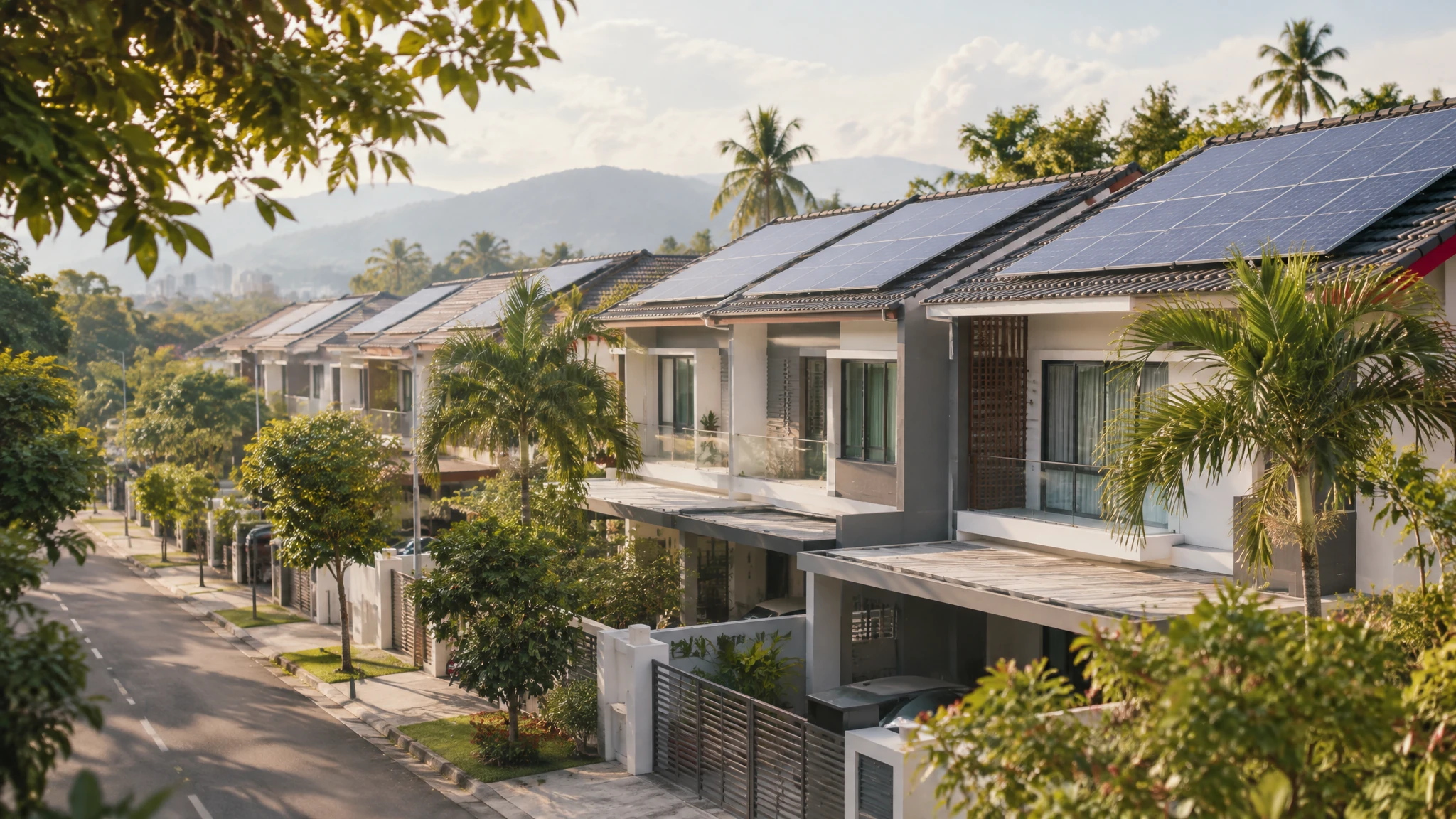
Solar ATAP (Solar Accelerated Transition Action Programme) is Malaysia’s rooftop solar scheme, effective 1 January 2026, replacing Net Energy Metering (NEM). You use the power you generate and export the surplus to TNB for credits that offset your bill. Homes can install up to 5 kW single-phase or 15 kW three-phase.
Key facts
- Solar ATAP took effect on 1 January 2026 and succeeds NEM, which closed to new applicants on 30 June 2025.
- Domestic limits: up to 5 kW (single-phase) or 15 kW (three-phase).
- Non-domestic limit: up to 100% of Maximum Demand (MD), capped at 1 MW.
- Surplus energy is exported to TNB for credits that offset electricity charges.
- The Energy Commission published the guidelines on 31 December 2025; applications go through SEDA.
What is Solar ATAP?
Solar ATAP is the government programme that lets homes and businesses install rooftop solar, use the electricity themselves, and export any surplus to the grid run by Tenaga Nasional Berhad (TNB). The programme opened on 1 January 2026, after the guidelines were released on 31 December 2025 (Bernama).
It is built around self-consumption. The more of your solar output you use during the day, the less grid electricity you buy, so exports are a bonus rather than the main goal.
How do Solar ATAP export credits work?
Exported energy earns credits, and the credits reduce the electricity charges on your bill. They are not paid out as cash. The value of a credit depends on who you are.
Domestic consumers are credited at the prevailing energy charge. Non-domestic consumers are credited at the System Marginal Price (SMP), the wholesale electricity price, which moves with the market. That is why a business gains most by using its own solar power on site, while a home with a steady daytime load gets a predictable credit.
How is Solar ATAP different from NEM?
NEM, the earlier net metering scheme, closed to new applicants on 30 June 2025. Solar ATAP is its successor and runs on different credit rules and limits.
| Item | NEM | Solar ATAP |
|---|---|---|
| Status | Closed to new applicants on 30 June 2025 | Open from 1 January 2026 |
| Existing contracts | Stay valid under their own terms | Open to NEM users who terminate first |
| Credit basis | One-to-one offset of exports against imports | Energy charge (domestic) or SMP (non-domestic) |
Source: the Ministry of Energy Transition and Water Transformation (PETRA), as reported by The Star. The question of whether to move is covered in switching from NEM to Solar ATAP.
How much can I install under Solar ATAP?
The limits depend on the type of account.
| Consumer type | Maximum system capacity |
|---|---|
| Domestic, single-phase | 5 kW |
| Domestic, three-phase | 15 kW |
| Non-domestic | 100% of Maximum Demand, capped at 1 MW |
These are ceilings, not targets. A system sized to your daytime consumption usually gives the best return, because self-consumption avoids the full tariff, while exports offset only the energy charge. To see whether your property fits, read the Solar ATAP eligibility checklist.
How does Solar ATAP work for businesses?
Factories, offices and retail premises can install up to 100% of their Maximum Demand, with a 1 MW ceiling. Because a factory load usually runs while the sun is up, most of the output is consumed on site, and fixed grid charges continue regardless.
Larger or more complex loads may suit our commercial and industrial solar solutions, and the C&I ROI calculator gives an early view of payback.
How do I apply for Solar ATAP?
Applications go through the Sustainable Energy Development Authority (SEDA) portal. A registered installer normally prepares the technical submission, installs the system and handles commissioning with TNB. You can also run your property through the Solar ATAP eligibility calculator.
SEDA’s Solar ATAP guidelines page lists RM1,000 for domestic systems above 5 kW (single phase) or 15 kW (three phase). Non-domestic systems up to 72 kW pay no fee, and larger ones pay RM1,000 to RM8,000 by size. Homeowners may also qualify for the SuRIA Home rebate.
How ERS Energy helps
ERS Energy designs and installs residential solar systems sized to the Solar ATAP limits, and engineers commercial systems against a site’s Maximum Demand. With 2 GWp+ installed across 2,000+ projects since 2009, we model the credit basis for your account type against your real bills before recommending a system size.
Frequently asked questions
Who runs Solar ATAP?
The Energy Commission issued the guidelines, SEDA receives the applications, and TNB connects your system and applies the export credits to your bill once it is commissioned.
What documents does a Solar ATAP application need?
SEDA’s guidelines page lists the Solar ATAP contract, a copy of your identity card or an authorisation letter, and the testing and commissioning form. Your installer normally assembles these with the technical submission.
What is the System Marginal Price?
The System Marginal Price is the wholesale price of electricity in the Malaysian power system at a given time. Non-domestic Solar ATAP export credits follow it, so the credit per unit changes with market conditions.
Should I install the maximum size allowed?
Not necessarily. The limits are ceilings. A system matched to your daytime use earns more per unit than one that mainly exports, so size it from your bills and roof rather than from the cap.
Sources
Facts and figures may vary by the time you read this. This article is for general information only and is not financial, legal, tax or engineering advice. Always double-check key facts and figures with the relevant official source before relying on them.
Check whether your property qualifies and see your likely savings.
Try the Solar ATAP eligibility test