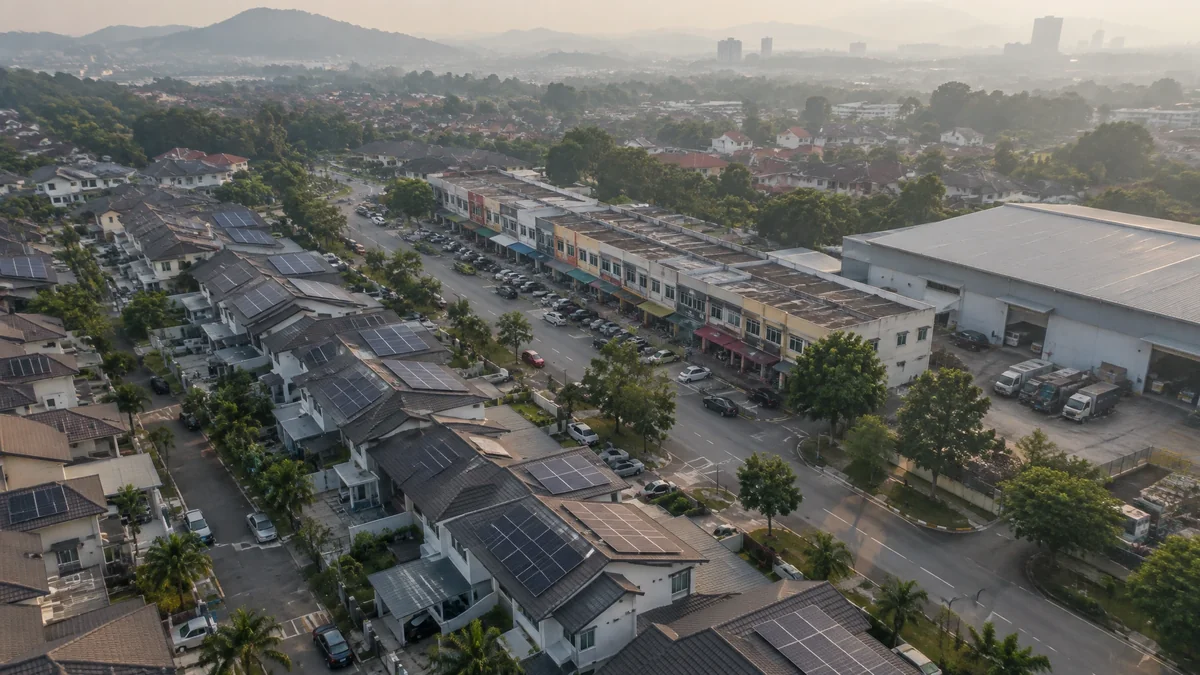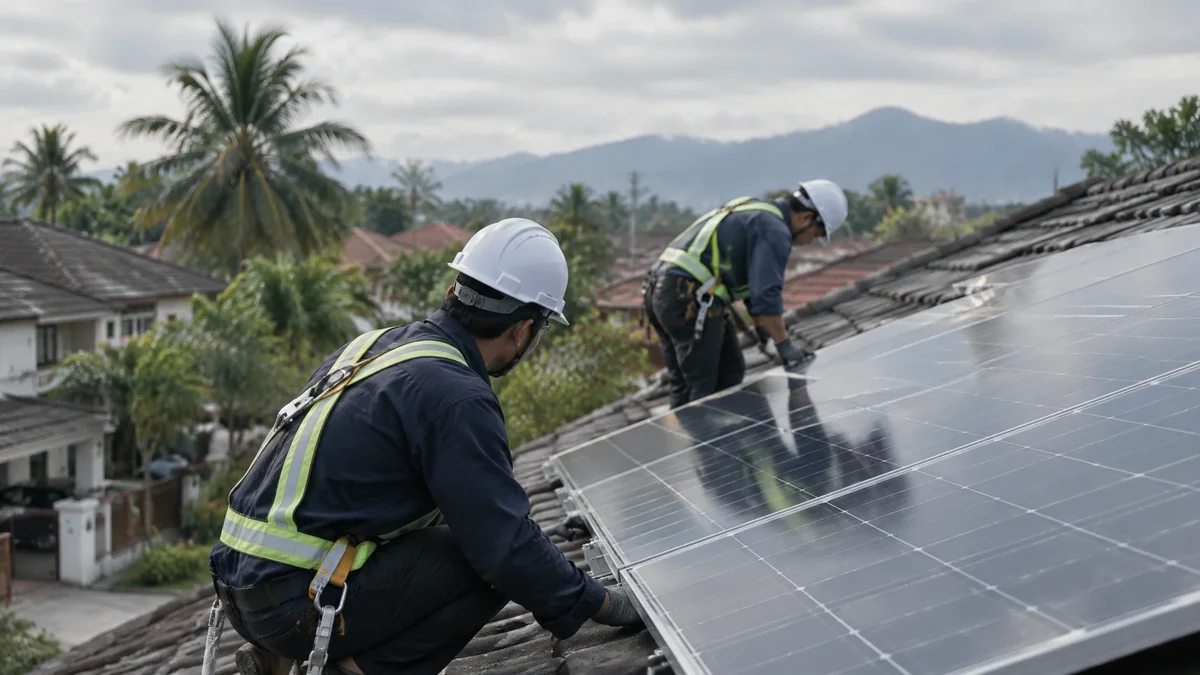
To buy solar power under CREAM, your premises must be within about 5 km of the Local Community Solar Plant, in Peninsular Malaysia, and registered as a low or medium voltage customer with the Electricity Utility Company (EUC) in any category. You may be an existing or new customer, and must own or occupy the premises.
Key facts
- Location rule: premises within a 5 km radius (approximately) of the Local Community Solar Plant (LCSP).
- Must operate in Peninsular Malaysia; the plant must be on landed homes, 100 kWp to 2 MWp per 11 kV feeder.
- Must be a registered low or medium voltage consumer under any category with the EUC, for example TNB.
- May be an existing or a new EUC customer, and must own or occupy the premises.
- Price is negotiated in a Bilateral Energy Supply Contract, with the EUC as supplier of last resort.
Who can become a Local Green Consumer?
A business that wants to become a Local Green Consumer must meet four conditions. It is registered as a low or medium voltage consumer under any category with the EUC, it operates in Peninsular Malaysia, it may be an existing or new EUC customer, and it owns or occupies the premises that need the electricity.
The criteria do not include a minimum size or corporate threshold. That is the main difference from the Corporate Green Power Programme (CGPP) and the Corporate Renewable Energy Supply Scheme (CRESS), which suited large energy users.
Homeowners often ask who qualifies for CREAM as well. A homeowner qualifies by owning a landed property; see renting your roof under CREAM.
How does the 5 km rule work?
Your premises must sit within a 5 km radius of the LCSP you want to source electricity from, determined by substation. The Energy Commission CREAM Guidelines describe the distance as approximately five kilometres, and power is delivered through TNB’s distribution system.
In practice, eligibility is site-specific. Two factories in the same industrial park can qualify for one plant but not another, so ask the LEGA to state the distance from the plant to your meter before you negotiate.
How is the electricity price set?
You negotiate the price directly with the nearby plant owner, in a Bilateral Energy Supply Contract, which also governs payment terms. No standard tariff is imposed. Several terms are worth testing alongside the rate.
| Term | Why it matters |
|---|---|
| Rate per kWh and escalation | Sets your long-run saving against the EUC tariff |
| Contract duration | Aligns with your lease or site horizon |
| Volume and export share | Limited to the plant’s registered export energy |
| Green attributes | Belong to the LEGA by default and can be transferred to you by contract |
One caveat on green attributes: if the LEGA sells Excess Energy, meaning output above its consumers’ contracted demand, through the New Enhanced Dispatch Arrangement (NEDA) at a nominal rate such as 8 sen/kWh, those attributes are forfeited to the Single Buyer. The effect on ESG claims is covered in CREAM certificates and ESG reporting.
The network charge is separate from your negotiated rate and is paid by the LEGA, not the consumer. The Community Access Charge (CAC) is 9 sen/kWh, a single rate for firm and non-firm supply, from the fourth Regulatory Period (Energy Commission, 29 August 2025). It is fixed for three years and any revision is capped at 15%.
What happens to the power I cannot get from the plant?
Your business stays connected to the national grid. The EUC acts as your supplier of last resort and covers any shortfall. You pay the LEGA for the green electricity delivered and the EUC only for the remaining balance. Read more in what happens when the solar plant stops generating.
How do I check whether I qualify?
First, confirm on your bill that your supply category is low or medium voltage. Second, locate LEGA plants near your premises. There is no public register of plants, so the LEGA is the practical source; the Energy Commission’s CREAM page carries the guidelines and updates. Third, ask the LEGA to confirm in writing that your site falls within 5 km and to share a draft contract.
How ERS Energy helps
Bring your latest TNB bill and we compare a CREAM contract against a rooftop system of your own, using your load and roof area. ERS Energy has delivered solar since 2009, with 2 GWp+ installed across 2,000+ projects in six markets. Explore our commercial and industrial solar services or read the CREAM overview.
Frequently asked questions
Can a tenant business use CREAM?
Yes, if it occupies the premises. The criteria require the consumer to own or occupy the site that needs electricity, so a tenant with its own low or medium voltage account can qualify.
Is CREAM electricity cheaper than my TNB tariff?
It is not fixed. The price is negotiated, so the saving depends on the rate and escalation you agree. Compare the LEGA’s offer with your current tariff over the full contract term.
Can I join if I am not yet a TNB customer?
Yes. The criteria allow a new EUC customer as well as an existing one, provided the premises are registered as low or medium voltage.
Sources
Facts and figures may vary by the time you read this. This article is for general information only and is not financial, legal, tax or engineering advice. Always double-check key facts and figures with the relevant official source before relying on them.
Not sure if your premises qualify? Bring your TNB bill and we will check.
Request an assessment