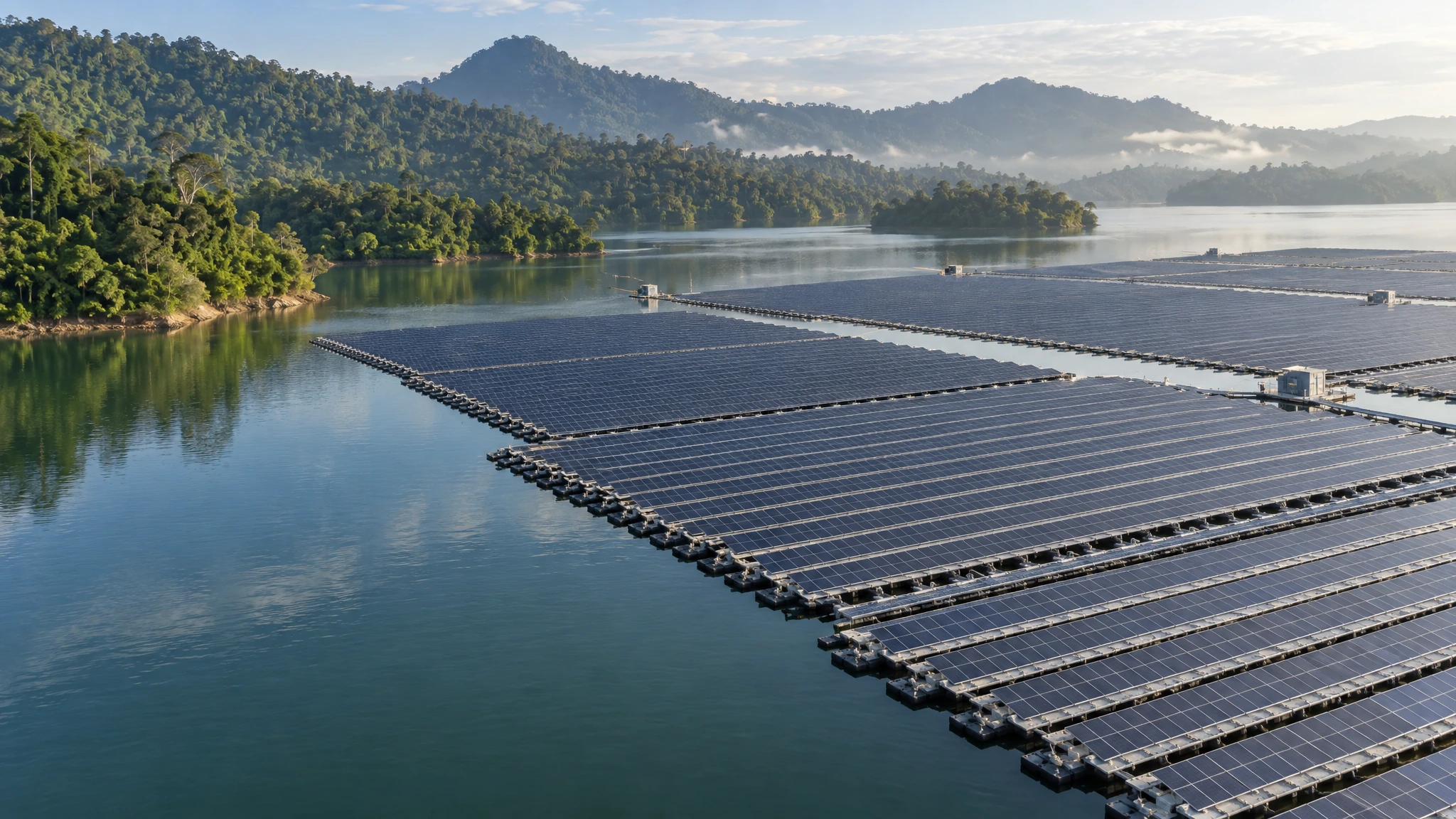
Floating solar mounts photovoltaic modules on buoyant platforms anchored on reservoirs, lakes or ponds, with cables running to an inverter on shore or on the platform. It suits Malaysia where land is scarce or costly and a suitable water body exists. It usually costs more per watt than a ground mount, so site conditions decide.
Key facts
- Modules sit on floats made for water use, held in place by anchors or mooring lines.
- Water levels, wind, anchoring and water-quality rules drive the engineering.
- The water body’s owner must agree to the use, and environmental review covers water quality and aquatic life.
- Malaysia’s fifth Large-Scale Solar round includes a dedicated floating package; see our LSS5 article for the package details.
How is a floating solar plant built?
A floating plant has five main parts: the floats, the modules, the anchoring system, the electrical system and the shore connection. Floats are engineered for use on water and are joined into arrays that carry the modules at a fixed tilt above the water. The array is held in position by anchors or mooring lines that allow for changing water levels.
Direct current cables run across the array to combiner boxes and inverters, which may be on floating platforms or on the bank. Power then travels by cable to a substation and the grid connection. Engineers must design for wind load, wave action, corrosion and safe access for maintenance crews.
What are the advantages of floating solar?
- It saves land. Panels use water surface that is otherwise unproductive, which matters in land-scarce or high-value areas.
- It can use existing infrastructure. Reservoirs and hydropower lakes often sit close to transmission lines.
- Cooler operation is often cited. Water can help keep modules cooler, which can raise efficiency. The effect varies by site and should be confirmed by a yield study.
- It may reduce evaporation. Shading part of a reservoir can cut water loss, but the size of the benefit depends on coverage and climate.
What are the drawbacks and risks?
Floating systems cost more to engineer than a simple ground mount because of the floats, anchoring and marine-grade electrical work. Operations are harder, since crews reach arrays by boat or walkway, and the plant must cope with floating debris, algae and lightning.
| Factor | Floating solar | Ground-mounted solar |
|---|---|---|
| Land need | None (water surface) | Significant |
| Engineering | Floats, mooring, marine-grade cabling | Piles and racking |
| Maintenance access | Boat or walkway | Vehicle and foot |
| Approvals | Water body owner, environmental review | Land title, zoning |
When does floating solar make sense in Malaysia?
It makes sense when a suitable water body is available, the owner agrees to the use, land alternatives are scarce or expensive, and a grid connection is close.
Policy is also supportive: the Energy Commission’s fifth Large-Scale Solar round (LSS5) includes a package reserved for floating plants. The package sizes, quotas and ownership rules are set out in our LSS5 guide, based on the request for proposal as reported by The Edge.
How ERS Energy helps
ERS Energy has been an engineering, procurement, construction and commissioning (EPCC) contractor since 2009, with 2 GWp+ installed across 2,000+ projects, and it has delivered floating solar; see our projects page. We also engineer utility-scale solar and are building the 52 MWac Kampung Gajah project under LSS5, with energisation expected in early 2027. At ENGINEER & MARVEX 2026 we showed a floating solar structure with Sungrow.
Frequently asked questions
Is floating solar more expensive than ground-mounted solar?
Usually yes per watt, because of the floats, anchoring and marine-grade electrical work. The gap can close where land is costly or unavailable. A site-specific cost and yield comparison is the only reliable way to decide.
Can floating solar be installed on the sea in Malaysia?
Most projects use calm inland waters such as reservoirs, lakes and ponds. Open-sea installations face waves, salt corrosion and stricter approvals, so they are less common and need specialist marine engineering and extra approvals.
Does floating solar harm water quality?
Effects depend on coverage and site. Environmental assessments look at light penetration, oxygen levels and aquatic life, and the authority that owns the water body normally sets conditions before approval.
How does a floating solar plant connect to the grid?
Direct current cables run across the array to combiner boxes and inverters, which may sit on floating platforms or on the bank. Power then travels by cable to a substation and the grid connection, so the shore connection is designed alongside the floating array.
Sources
Facts and figures may vary by the time you read this. This article is for general information only and is not financial, legal, tax or engineering advice. Always double-check key facts and figures with the relevant official source before relying on them.
Planning a utility-scale solar project?
Talk to our utility-scale team