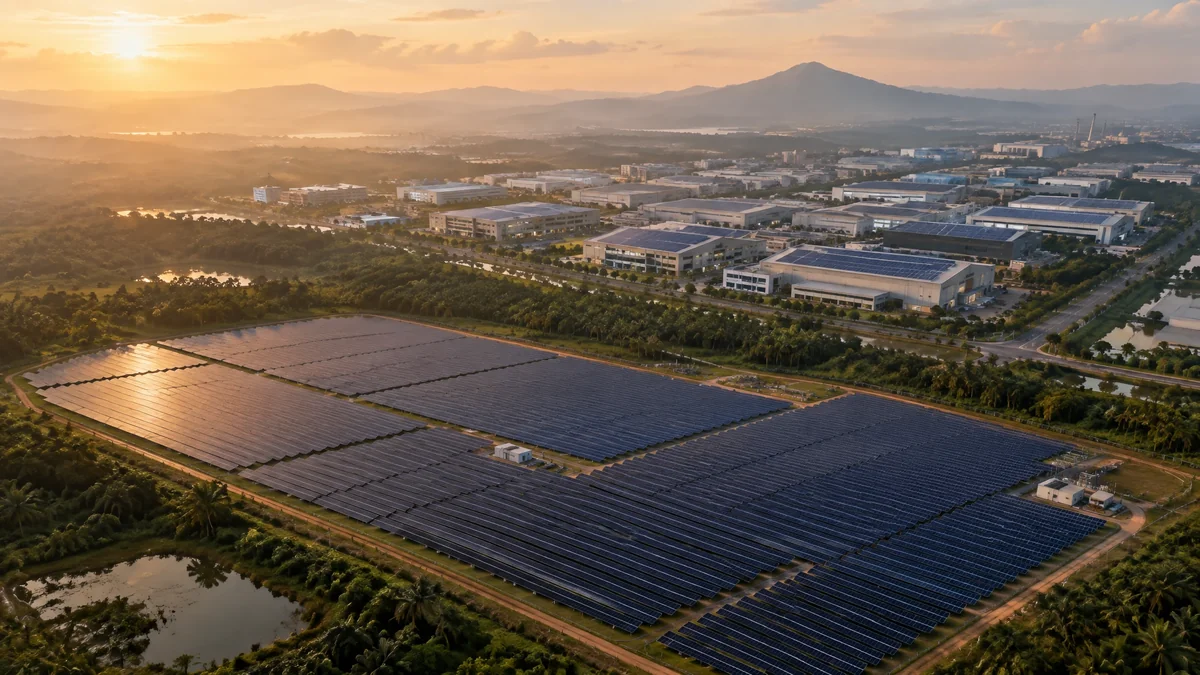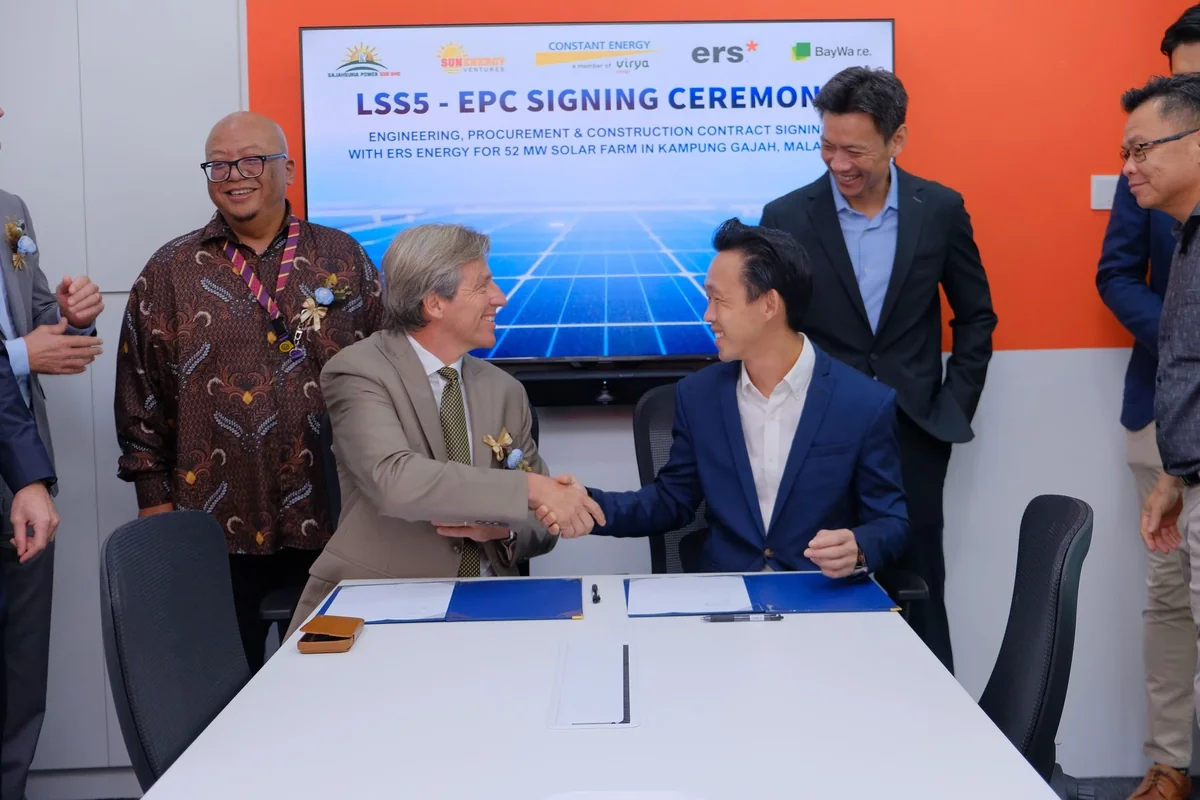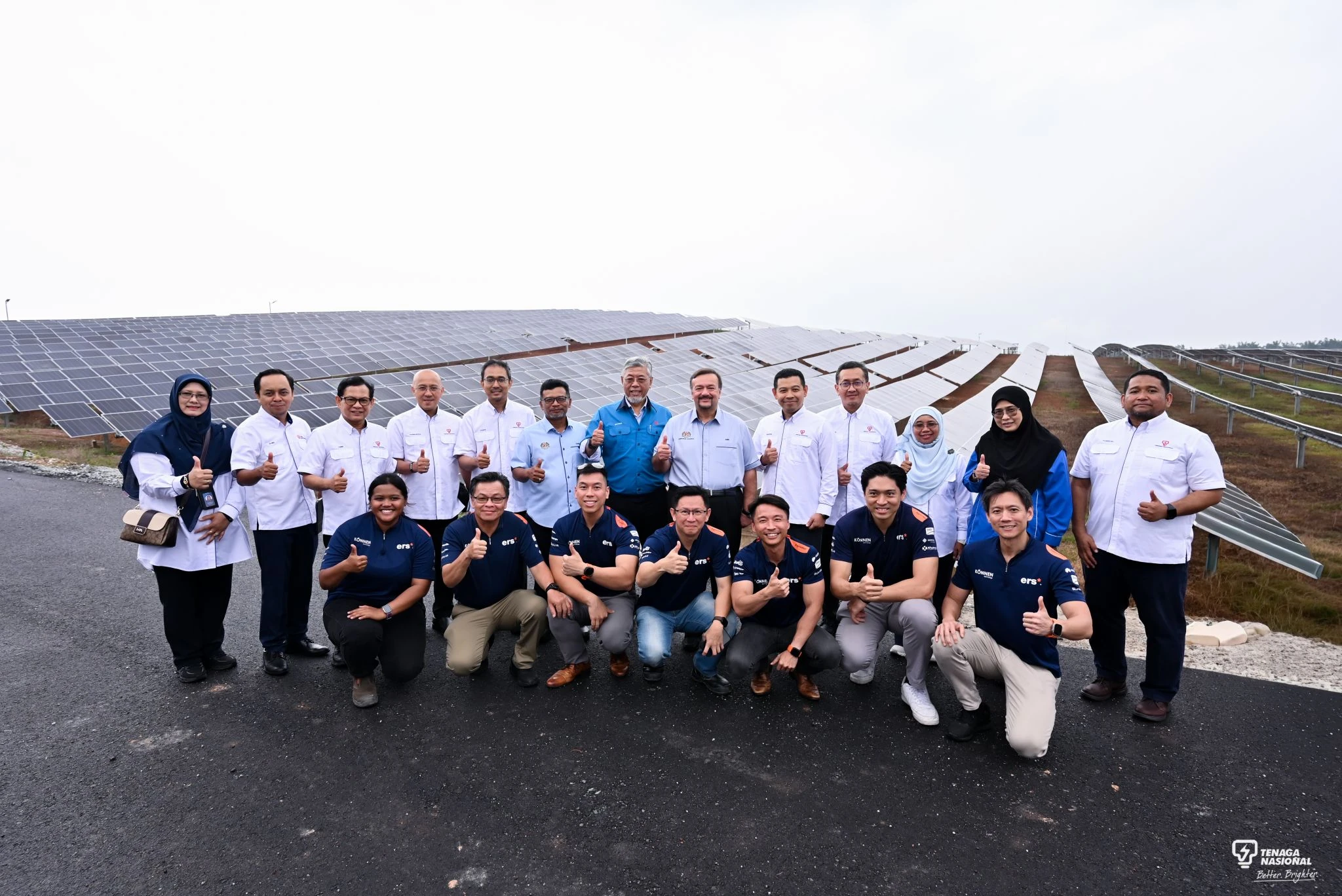
A single-axis tracker rotates solar modules from east to west to follow the sun, so they collect more irradiance across the day than fixed-tilt modules. TNB Bukit Sidim Kulim Solar in Kedah, a 45 MWp / 29.99 MWac Corporate Green Power Programme (CGPP) project, is TNB Renewables’ first solar farm to use tracking.
Key facts
- Project: TNB Bukit Sidim Kulim Solar (TBSKS), Kulim, Kedah.
- Size: 45 MWp / 29.99 MWac under the Corporate Green Power Programme (CGPP).
- Owner: TNB Renewables, part of Tenaga Nasional Berhad (TNB). ERS Energy was the EPCC contractor.
- Technology: single-axis tracking by Nextpower, Trinasolar Asia Pacific modules and Huawei Digital Power smart string inverters.
- Offtake: green electricity for semiconductor manufacturing, under CGPP’s financial arrangement.
- Status: commissioned September 2026.
What is a single-axis tracker?
A single-axis tracker is a mounting structure that tilts rows of solar modules about one horizontal axis, usually running north to south. A motor and control system turn the modules from facing east in the morning to facing west in the evening. Fixed-tilt structures stay at one angle all year.
Because the modules stay closer to perpendicular to the sun’s rays for more hours, they receive more usable irradiance. The daily output curve also becomes broader and flatter, with more generation in the early morning and late afternoon.
How much more energy does a tracker produce?
The gain depends on latitude, climate, module type and layout, so it should be modelled site by site. A commonly quoted range for single-axis tracking against fixed tilt is roughly 15 to 25 per cent more annual energy, as summarised in research from the US National Renewable Energy Laboratory (NREL). See the NREL publication on single-axis tracking. A Malaysia-specific figure needs a site yield assessment.
Malaysia sits close to the equator, where the sun’s daily arc is more overhead than at higher latitudes, and cloud cover is frequent. The 15 to 25 per cent figure is therefore not a Malaysia figure, and the gain here may be lower. A developer runs a site-specific energy yield model before choosing between trackers and fixed tilt.
What is the trade-off?
| Factor | Single-axis tracker | Fixed tilt |
|---|---|---|
| Energy per kWp | Higher, with a broader daily curve | Lower, peaks around midday |
| Moving parts | Motors, controllers, drive lines | None |
| Land and spacing | More attention to row spacing and shading | Simpler layout |
| Operations and maintenance | Needs tracker inspection and software checks | Minimal |
| Best fit | Flat, open ground and value in a longer generation window | Constrained sites and rooftops |
The extra energy only pays off if the tracker’s added capital and maintenance cost is lower than the value of that energy. For ground-mounted plants with a buyer that values steady daytime supply, that case can be strong.
What is special about the Bukit Sidim project?
TNB Bukit Sidim Kulim Solar has a DC capacity of 45 MWp and an AC export capacity of 29.99 MWac. That is a DC-to-AC ratio of about 1.5 (45 / 29.99). CGPP is a virtual power purchase arrangement: as Skrine summarises, the plant exports to the grid and the corporate buyer settles financially, with no physical delivery. CGPP is now closed to new applicants; see our comparison of CGPP, CRESS and CREAM.
It is TNB Renewables’ first solar farm equipped with single-axis tracking. The tracking system is from Nextpower, the modules are Trinasolar Asia Pacific and the smart string inverters are from Huawei Digital Power.
How ERS Energy helps
ERS Energy has been an engineering, procurement, construction and commissioning (EPCC) contractor since 2009, with more than 2 GWp+ installed across over 2,000 projects in six markets (Malaysia, Singapore, Vietnam, Indonesia, the Philippines and Australia). The company is certified to ISO 9001, ISO 14001 and ISO 45001. At Bukit Sidim, ERS Energy was the EPCC contractor from engineering through to commissioning, and we worked with TNB Renewables and the technology partners named above. See more of our utility-scale projects or how we approach utility-scale solar.
Frequently asked questions
Do single-axis trackers work in cloudy tropical weather?
They still work, but the gain is smaller on heavily overcast days because most light is diffuse and comes from all directions. A yield model using local irradiance data shows whether the extra tracker cost is justified for a given site.
What is CGPP in Malaysia?
The Corporate Green Power Programme (CGPP) was a virtual power purchase arrangement. The plant exports to the grid, and the corporate buyer settles the difference against a fixed price, with no physical delivery. It was a one-off round that closed in February 2023.
What does an EPCC contractor do on a solar farm?
An EPCC contractor designs the plant, procures modules, trackers and inverters, builds it on site, and commissions it to the grid connection. It carries delivery, schedule and performance responsibility for the owner, here TNB Renewables.
Sources
Facts and figures may vary by the time you read this. This article is for general information only and is not financial, legal, tax or engineering advice. Always double-check key facts and figures with the relevant official source before relying on them.
Planning a utility-scale or corporate green power project?
Explore utility-scale solar