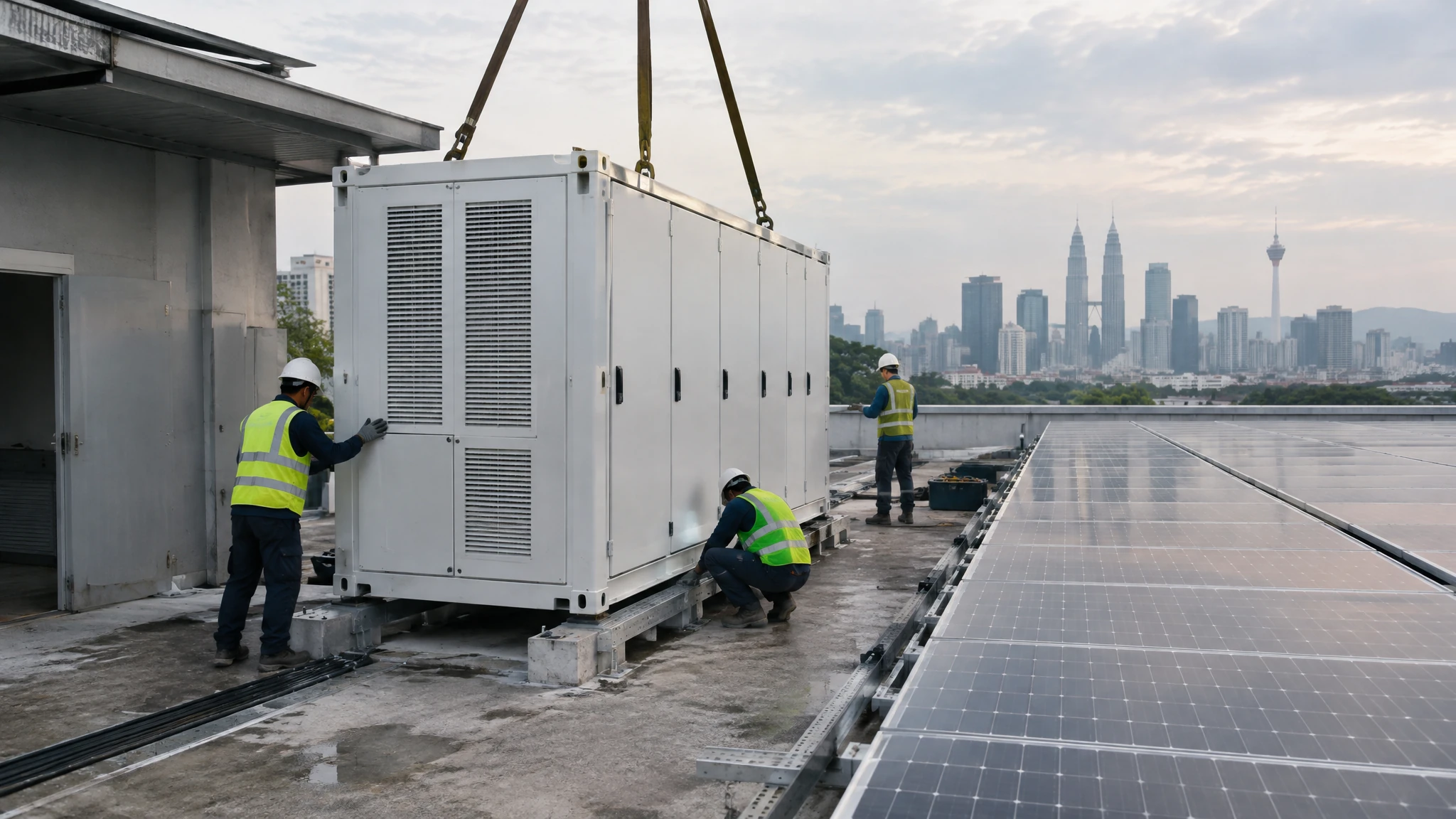
Often, yes. A battery energy storage system (BESS) can be retrofitted onto an existing solar PV system, including commercial rooftops. Feasibility depends on your inverters, electrical layout, space and safety requirements, so an engineering assessment comes first.
Key facts
- BESS can be retrofitted onto existing PV systems, not only installed with new solar.
- Feasibility turns on inverter coupling (AC or DC), switchboard capacity, space and approvals.
- A retrofit can lower bills and improve peak-hour supply, depending on tariff and load.
- Start an assessment with your TNB bill and your current system’s inverter details.
Why retrofit a battery instead of replacing the solar system?
Many commercial and industrial buildings already have rooftop solar. Adding storage to that asset is usually less disruptive than starting again. The panels keep producing, and the battery changes when the energy is used. This article covers the technical checks; for the tariff economics at factory scale, see Solar + BESS for Malaysian factories.
What decides whether your system can take a battery?
Retrofit feasibility is an engineering question. The main factors are:
- Inverter type: whether the existing inverters can be paired with a battery or whether additional power conversion equipment is needed. In an AC-coupled retrofit the battery has its own inverter and connects on the AC side, leaving the existing solar inverters in place. In a DC-coupled retrofit the battery connects on the DC side, usually through a hybrid inverter.
- Electrical layout: available capacity at the main switchboard and the point of connection.
- Space and ventilation: a suitable, accessible location for the battery enclosure.
- Safety and approvals: fire protection, clearances and any utility or authority requirements. Ask your contractor to confirm the applicable standards and the TNB and Energy Commission approvals for your connection type before design is fixed.
- Your load profile: when you use power, and when your solar produces more than you need.
How does a BESS retrofit work in practice?
An assessment normally follows a fixed sequence. First, engineers review your bill, demand data and the existing system’s documentation. Second, they inspect the site and the electrical room. Third, they model how a battery of a given size would change your bill. Only then is a system specified.
The battery’s size is a trade-off between cost and the share of peak-hour load you want to cover. A smaller unit may target peak reduction only, while a larger unit can also provide backup for selected circuits. Sizing is settled only after the site assessment, from your demand data.
What decides whether a retrofit pays off?
Three things drive the financial case. First, your maximum demand charge: a battery that discharges in your highest half-hours can lower it. Second, the gap between peak and off-peak energy rates, where your tariff category has one. Third, what your surplus solar is worth when exported, compared with storing it and using it later on site.
If you are choosing between buying and financing, the investment structuring page sets out the ways projects can be funded, and the C&I ROI tools help you weigh what your roof is worth.
How ERS Energy helps
ERS Energy has been an engineering, procurement, construction and commissioning (EPCC) contractor since 2009, with 2 GWp+ installed across 2,000+ projects in six markets and ISO 9001, 14001 and 45001 certification. Because an EPCC contractor handles design, installation and commissioning, one team can check your existing inverters and switchboard and then specify the battery. For grid-scale storage, see What is MyBeST. See commercial and industrial solar and our solutions.
Frequently asked questions
Do I need the original installer to retrofit a battery?
Not necessarily. A qualified EPCC contractor can assess and integrate storage with an existing system. It will need the system’s documentation, inverter details and access to the electrical room, and it must confirm that warranties on existing equipment remain valid.
Will adding a battery void my existing solar warranty?
It can, depending on the equipment and how the integration is done. Check the warranty terms for your inverters and modules, and ask your contractor to confirm compatibility in writing before any work starts.
How long does a BESS retrofit take?
Duration depends on system size, equipment lead times and approvals. A small retrofit is shorter than a large industrial one. Expect the design, equipment lead time and approvals to take longer than the installation itself, and ask for a schedule after the site assessment.
What should I prepare for a retrofit assessment?
Gather your latest TNB bills, single-line diagram or electrical drawings if you have them, and details of the existing solar system such as inverter model and capacity. These let engineers judge compatibility faster.
Facts and figures may vary by the time you read this. This article is for general information only and is not financial, legal, tax or engineering advice. Always double-check key facts and figures with the relevant official source before relying on them.
Have a rooftop system and thinking about storage? Ask our engineers about a BESS retrofit.
Discuss a BESS retrofit